Notes from the Balcony

Ongoing comment and dialogue on being a new church in a new world - A Blog by John Montgomery

[The Bible] is not, for a start, a list of rules, though it contains many commandments of various sorts and in various contexts. Nor is it a compendium of true doctrines, though, of course, many parts of the Bible declare great truths about God, Jesus, the world and ourselves in no uncertain terms. Most of its constituent parts, and all of it when put together (whether in the Jewish canonical form or the Christian form), can best be described as story. This is a complicated and much-discussed theme, but there is nothing to be gained by ignoring it. - N.T. Wright

Saturday, September 29, 2007

The Narrative Character of the Bible (Pt. 1)

NT Wright on the Bible and Narrative Theology


[I'm in the process of beginning to write on the narrative character of the Bible - I thought a good place to start might be to share some comments from others. I'll begin with an Evangelical voice!]

"It's not, for a start, a list of rules, though it contains many commandments of various sorts and in various contexts. Nor is it a compendium of true doctrines, though of course many parts of the Bible declare great truths about God, Jesus, the world and ourselves in no uncertain terms. Most of its constituent parts, and all of it when put together (whether in the Jewish canonical form or the Christian one), can best be described as story. This is a complicated and much-discussed theme, but there is nothing to be gained by ignoring it.

"The question is, How can a story be authoritative? If the commanding officer walks into the barrack-room and begins 'Once upon a time,' the soldiers are likely to be puzzled. If the secretary of the cycling club pins up a notice which, instead of listing times for outings, offers a short story, the members will not know when to turn up. At first sight, what we think of as 'authority' and what we know as 'story' do not readily fit together.

"But a moment's thought suggests that, at deeper levels, there is more to it than that. For a start, the commanding officer might well need to brief the soldiers about what has been going on over the past few weeks, so that they will understand the sensitivities and internal dynamics of the peace-keeping task they are now to undertake. The narrative will bring them up to date; now it will be their task to act out the next chapter in the ongoing saga. Or supposing the secretary of the club, having attempted unsuccessfully to make the members more conscious of safety procedures, decides to try a different tack, and puts up a notice consisting simply of a tragic story, without further comment, of a cyclist who ignored the rules and came to grief. In both cases we would understand that some kind of 'authority' was being exercised, and probably all the more effectively than through a simple list of commands.

"There are other ways, too, in which stories can wield the power to change the way people think and behave - in other words, can exercise power and/or authority...A familiar story told with a new twist in the tail jolts people into thinking differently about themselves and the world. A story told with pathos, humor or drama opens the imagination and invites readers and hearers to imagine themselves in similar situations, offering new insights about God an human beings which enable them then to order their own lives more wisely.

"All of these examples, and many more besides which one might easily think of, are ways in which the Bible does in fact work, does in fact exercise authority. This strongly suggests that for the Bible to have the effect it seems to be designed to have it will be necessary for the church to hear it as it is, not to chop it up in an effort to make it something else..."


- Bishop N.T. Wright, from The Last Word: Beyond the Bible Wars to a New Understanding of the Authority of Scripture (Harper San Francisco, 2005), pp.25-27.


Hat Tip: First published on Keith McIlwain’s Blog - Visit Keith's Blog

Friday, September 28, 2007

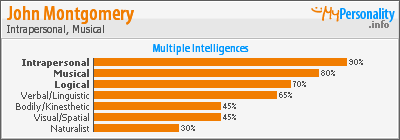
Am I Smart or Not?

Maybe this is why I am a blogger!

Actually, I was surprised that "musical" came in second!

Click to view my Personality Profile page

Tuesday, September 25, 2007

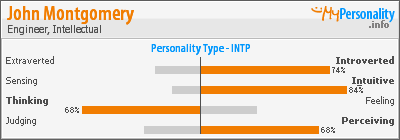
Is this telling or not?


Click to view my Personality Profile page

Oh My God - I'm Brian Griffin, the talking Dog on The Family Guy!
Well, I'm also Abroham Lincoln, Carl Jung and Gerald Ford.

"The INTP is above all a thinker and his inner (private) world is a place governed by a strong sense of logical structure. Every experience is to be rigorously analysed, the task of the INTP's mind is to fit each encountered idea or experience into a larger structure defined by logic."


Friday, September 21, 2007

Ethics and Responsibility

I’ve been reflecting on ethics recently. That is always dangerous for me, because when I get tied up with terms like deontology and teleology and contextual and situational, I get easily confused. I think I even made it through six years of graduate study without taking one ethics class! I don’t know whether to be glad or horrified.

Even so, folks have helped me see some basic notions. I have learned that in our day, our metaphors have shifted. While in the past we might readily talk of good and bad, or a little later talk of right and wrong, or truth and lies, in today’s world most of us talk about the difference between being responsible and irresponsible. H. Richard Niebuhr wrote about these ethical understandings in his classic text, The Responsible Self. I did read that text once upon a time. Others have helped me see that, like theology, ethics is about living as appropriately as we can and finally everybody is an ethicist one way or the other.

In his Letters from Prison (if I correctly recall), Bonhoeffer defined responsibility as standing in the perpetual tension between freedom and obedience. Bonhoeffer did not directly write challenging Sartre, whose existentialist philosophy celebrated freedom and responsibility. Bonhoeffer, was of course an existential theologian as well arguing for theology from the underside, but he also argued that obedience was always a part of the equation.

These two realities, freedom and obedience, (decision and commitment - choice and obligations) were always in tension and irresponsibility had to do with collapsing that tension. If one stood completely on the freedom pole, ignoring obedience, then one’s life becomes a caricature, we become an irresponsible genius. If one denied human freedom, one became a person of duty, one who is always simply following orders. Of course, in Bonhoeffer’s Germany the temptation to grovel in sheer obedience was most alluring. I would guess that today, we are tempted more to “do our own thing "or "to say we make our own rules."

For Bonhoeffer, what allowed a person to stand in this tension was the Word, not as some cheap formula, but as a lived event. So, if one finds oneself paralyzed with inaction because there are too many values to hold, or obligations to meet, the living word tells us to get off our duff and make a decision. A poster I once saw read, “Action Removes the Doubt that Inaction Can Never Solve.”

Or again, if one is living in the illusion that one’s decisions are solely their own business, the living word confronts that irresponsible genius with the innocent suffering of his/her neighbor, calling for a new sort of relatedness.

But what about social responsibility? I recently had lunch with my colleagues, Simon and Eunice, who attended Glenn Memorial while they were still students at Candler. Following seminary, they were assigned to the Louisiana conference and both serve parish churches in the devastated areas. Glenn has sent two separate work teams and is planning on further trips soon. We talked about the chaos and the job that still needs to be done in New Orleans and the coastal areas. I found myself reflecting on the ineptness of this administration’s FEMA agency. I found myself thinking that not only does responsibility have to do with affirming one’s personal interrelatedness, but it also has to do with insuring one's ability to respond. FEMA’s (and the present administration’s) irresponsibility was it’s unresponsiveness.

The tension between freedom and obedience is difficult, what keeps us dancing is the assurance that God, in God’s power can use whatever we offer up, mistakes and all.

Bonhoeffer points out that we always function in the twilight – good strives with good and more importantly evil with evil. There are times where we must in our authentic freedom chose between wrong and wrong not knowing which is the least of the two evils. I seem to remember that the “tree of the knowledge of good and evil” was off limits. Bonhoeffer’s decision to participate in a plot to overthrow Hitler witnesses to these difficult choices.

My point is that God in God’s grace gives us wide space to act without overwhelming guilt. My friend Rachel recently pointed out our alternative Psalm for this week (Psalm 4) where is says that “in my distress, God gives me space.” God gives me space, not to do whatever we want to do, but enough space to discern, albeit through a glass darkly, what our best vision of what God requires of us.

Bonhoeffer would say that we can then act freely, leaving the judgments to God. As I reflected, I found myself humming the old hymn tune – “there’s a wideness in God’s mercy.”

Indeed, Grace and Peace are yours.

John

Picture Used with Permission: Copyright - christine balderas

Thursday, September 20, 2007

Methoblog Weekly Round-Up 2007.31.129

This week's summary for the Methoblog project has just been published by Allan Bevere.

Visit Post

You will remember that a couple of weeks ago I made several statements about cell phone use particularly by members of the congregation during worship. Please check out Jason Byassee's reflections from Theoblog in my "What Others Are Saying" sidebar. He is focusing on the question of how wired must pastors themselves must be!

Have a great week.
Powered By Blogger